


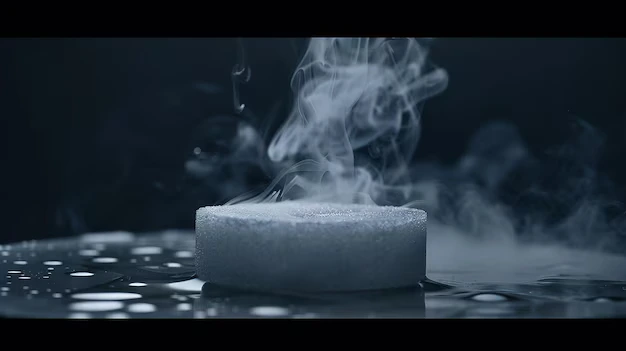
If you’ve searched “dryice” or “dry ice UAE” and landed here wanting a straight answer — dry ice is the solid form of carbon dioxide (CO₂), frozen to -78.5°C. It’s not related to regular water ice at all beyond the name and the cold. This guide walks through what it actually is, how it behaves differently from normal ice, the main ways people and businesses use it, and what to look for when choosing dry ice suppliers Dubai and Abu Dhabi companies rely on.
What Is Dry Ice, Exactly?
Regular ice is frozen water (H₂O). Dry ice is frozen carbon dioxide (CO₂) — a completely different substance that happens to also be very cold. The “dry” in the name comes from the fact that it never turns into a liquid as it warms up. Instead, it sublimates: it goes directly from a solid block straight into CO₂ gas, with no messy puddle left behind.
This single property — sublimation instead of melting — is why dry ice is used so differently from regular ice. There’s no water damage risk, no drips, and it gets far colder than a home freezer ever could.
How Dry Ice Is Made
Dry ice is produced by compressing and cooling carbon dioxide gas until it becomes a liquid, then rapidly releasing the pressure. This causes part of the CO₂ to freeze into a snow-like solid, which is then compressed into blocks, pellets, or slices depending on the intended use. Reputable dry ice suppliers Dubai and Abu Dhabi businesses use maintain strict purity and density standards during this process, since the quality of the compression directly affects how long the ice lasts and how cleanly it sublimates.
Dry Ice vs Regular Ice: The Key Differences
| Dry Ice (CO₂) | Regular Ice (H₂O) | |
| Temperature | -78.5°C | 0°C |
| Melts into | Nothing — turns straight to gas | Liquid water |
| Handling | Requires insulated gloves | Safe to touch briefly |
| Best for | Deep-freeze shipping, fog effects, industrial cleaning | Drinks, everyday cooling |
| Storage | Vented, insulated container | Standard freezer |
Because it’s so much colder and behaves so differently, dry ice isn’t a drop-in replacement for regular ice — it’s a different tool entirely, suited to specific jobs regular ice simply can’t do.
The Main Uses of Dry Ice
Food and Beverage Cold Chain Dry ice keeps frozen and perishable goods at consistently low temperatures during transport, without the risk of meltwater damaging packaging. This makes it a standard choice for shipping seafood, meat, and other perishables across the UAE and internationally.
Medical and Pharmaceutical Transport Vaccines, biological samples, and temperature-sensitive medications often require ultra-low, stable temperatures during transit. Dry ice is widely used across labs and hospitals in the UAE for exactly this reason — it holds a consistent deep-freeze temperature for hours without any liquid byproduct to manage.
Industrial and Equipment Cleaning Dry ice blasting uses small pellets fired at high pressure to clean machinery, electrical equipment, and industrial surfaces without water, chemicals, or abrasion damage. As it sublimates instantly on contact, there’s no residue left behind, which makes it popular for cleaning sensitive equipment that can’t get wet.
Events and Special Effects When dry ice meets warm, humid air, it produces a dense, low-lying fog — the effect behind countless weddings, stage shows, and concerts across Dubai and Abu Dhabi. It’s a reliable, cost-effective way to create dramatic atmosphere for events.
Everyday and Novelty Uses On a smaller scale, dry ice is used for chilling drinks and coolers, creating smoky effects in cocktails, science demonstrations, and even camping trips where regular ice isn’t practical for longer durations.
Dry Ice Formats: Pellets, Blocks, and Slices
Not all dry ice is the same shape, and the format matters for how it’s used:
- Pellets (3mm–18mm): Best for dry ice blasting, small coolers, and situations needing fast, even sublimation.
- Blocks (20mm–60mm+): Best for longer shipping durations, since larger surface-area-to-mass ratios mean they last significantly longer than pellets.
- Slices: A middle ground often used for food service and presentation, where a flatter form factor is easier to place.
Choosing the wrong format is one of the most common mistakes — pellets for a multi-day shipment will sublimate too quickly, while blocks for a fog machine won’t dissolve fast enough to produce a strong effect.
How to Choose Dry Ice Suppliers Dubai and Abu Dhabi Businesses Can Trust
If you’re sourcing dry ice regularly for a business — a restaurant, lab, or events company — a few things separate a reliable supplier from an inconsistent one:
- Consistent purity and density. Lower-quality production can mean faster, uneven sublimation, which is a real problem for time-sensitive shipments.
- Delivery speed and coverage. Dry ice has a limited shelf life once you have it, so a supplier that can deliver same-day across Dubai, Abu Dhabi, and the wider UAE matters more than it might for other supplies.
- Format range. A supplier that only stocks one pellet size will leave you improvising for jobs that need blocks or slices instead.
- Guidance, not just product. A good supplier should be able to advise on quantity and format for your specific use case — a lab shipment and a wedding fog effect need very different amounts and forms.
- Proper packaging for transport. Insulated containers and correct handling instructions on delivery reduce waste and prevent avoidable safety issues on your end.
Is Dry Ice Safe? A Quick Overview
Dry ice is safe when handled correctly, but it isn’t something to treat casually. Because it sits at -78.5°C, direct skin contact can cause burns similar to frostbite within seconds, so insulated gloves or tongs are essential whenever it’s being handled. Because it sublimates into CO₂ gas, it should never be stored in a fully sealed, airtight container — pressure can build up with nowhere to escape. And because that same gas can build up in small enclosed spaces, good ventilation matters whether it’s sitting in a kitchen, a walk-in cooler, or the back seat of a car on a long drive in UAE heat. None of this makes dry ice unusually dangerous to use — it just requires understanding that it behaves differently from the ice most people are used to.
Environmental Considerations
One advantage of dry ice over some alternative cooling and cleaning methods is that it leaves nothing behind. In cold-chain shipping, it eliminates meltwater damage and the need for gel packs that often end up as waste. In industrial cleaning, dry ice blasting removes the need for chemical solvents and abrasive media, since the CO₂ simply sublimates away after use, leaving no residue to dispose of. That said, dry ice is still CO₂, so businesses using it at scale — particularly for cleaning or fog effects — often factor ventilation and quantity into their environmental and safety planning, especially in enclosed venues.
Choosing the Right Quantity
Estimating how much dry ice you need depends heavily on the job. A cooler being used to keep drinks cold for a few hours at a party needs a very different amount than a multi-day international shipment of biological samples. As a general guide, expect a well-insulated cooler to lose roughly 5–10% of its dry ice mass per day to sublimation, with faster loss in hot conditions or containers that are opened frequently. For anything time-sensitive or safety-critical — medical transport in particular — it’s worth confirming exact quantities with a supplier who can account for your specific container, duration, and ambient conditions rather than guessing.
Common Questions About Dry Ice in the UAE
Is dry ice the same as regular ice, just colder?
No — they’re chemically different substances (CO₂ vs H₂O) with different behavior, uses, and handling requirements. Dry ice never becomes liquid.
Can I buy dry ice in small quantities?
Yes, most suppliers offer smaller pellet and block sizes suitable for personal or one-off event use, not just bulk industrial orders.
How quickly can dry ice be delivered in Dubai or Abu Dhabi?
Many established dry ice suppliers Dubai and Abu Dhabi businesses use offer same-day delivery, which matters given how quickly dry ice sublimates once produced.
Does dry ice go by other names?
It’s sometimes referred to simply as “dryice” as a single word, or as “solid CO₂” — all referring to the same product.
Sourcing Dry Ice in the UAE
Whether you need dry ice UAE-wide for a one-off event, a recurring lab supply, or cold-chain shipping, Dry Ice Abu Dhabi produces and delivers pellets, blocks, and slices across Abu Dhabi, Dubai, and the surrounding Emirates, with guidance on choosing the right format and quantity for your specific use.
Order dry ice via WhatsApp or call +971 55 363 5753.